

Design FMEA: Assigning Prevention and Detection Controls Correctly
Hardly any question takes up as much time in DFMEA workshops as this one: is this a prevention control or a detection control? Many teams fall back on a rule of thumb taken from the project plan: controls before design freeze count as prevention, all controls after it count as detection.
The result is classifications that change with the date. The same control improves Occurrence at one point and Detection at another. As a consequence, the Action Priority points in a direction that has nothing to do with the design.
After reading this article, you will be able to classify every control in your DFMEA as a prevention or detection control using a clear rule, and to recognize the three most common misclassifications in the workshop.
Two types of controls, two ratings
Step 5 of the AIAG/VDA FMEA Handbook, the Risk Analysis, strictly separates the two types of controls. Prevention controls (PC) feed into the Occurrence (O) rating, detection controls (DC) into the Detection (D) rating. Both generate knowledge, but they use it in different ways.
Prevention control: knowledge for the design
A prevention control generates design knowledge and applies it to the design. Through robust design, it reduces the occurrence of the failure cause. Every deliberate design decision based on a reliable foundation belongs here and is typically worded in the form sheet as "Design according to [knowledge source]". Examples include calculation, simulation, tolerance analysis or a validated carry-over from a predecessor product.
Detection control: knowledge for the evidence
A detection control detects the failure cause or the failure mode before the component is released for production. To do so, it verifies the function and validates the requirement during development on the real object. Typical examples are prototype tests, DVP&R measurements against the target value, endurance runs and functional tests. The knowledge generated serves as evidence.
The decision rule: the direction of knowledge
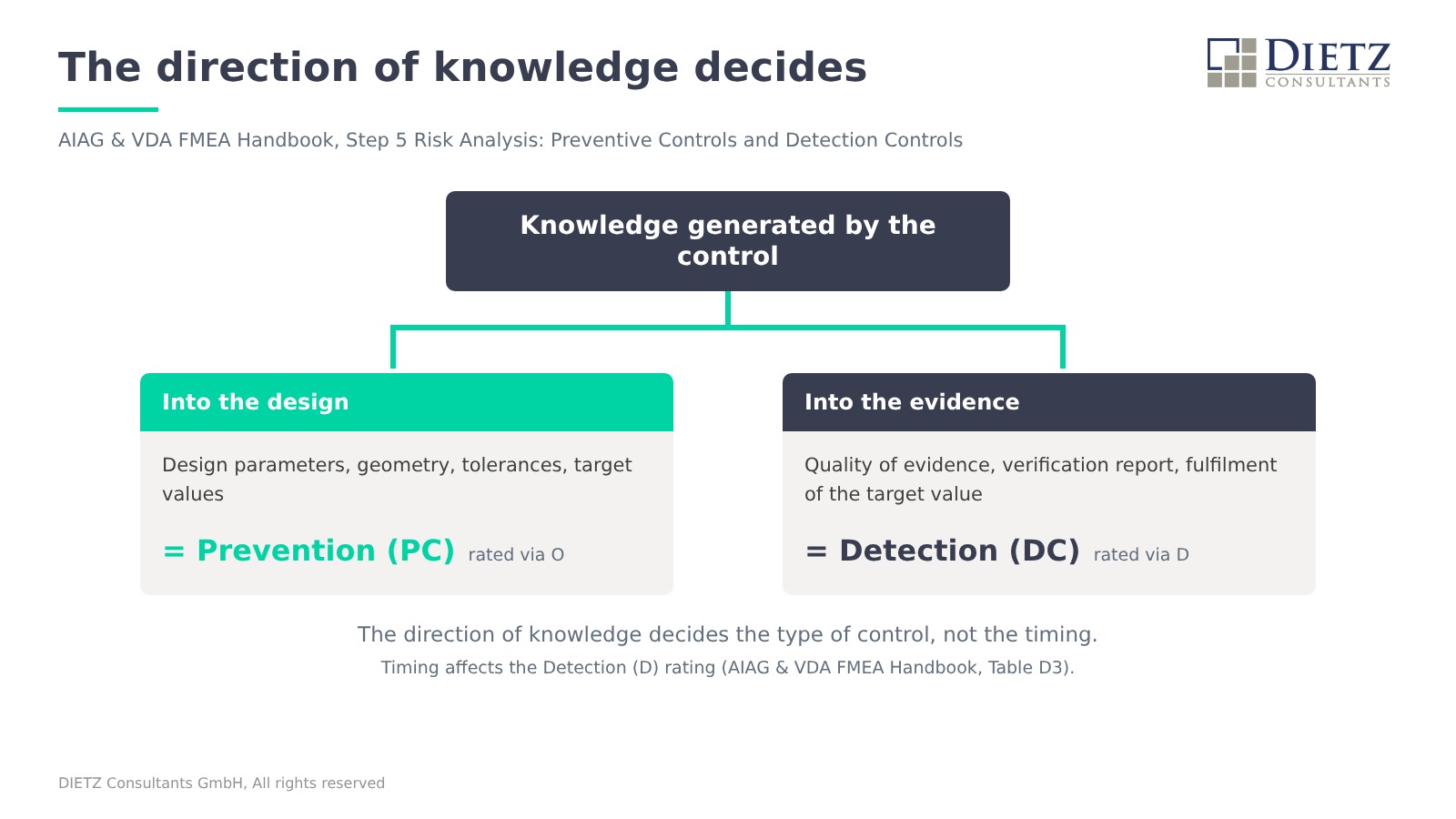
Since both types of controls generate knowledge, it is not the amount of knowledge that decides the classification, but its direction (see Figure 1).
- If the knowledge flows into the design, i.e. into design parameters, geometry, tolerances or target values, the control is a prevention control and is rated via Occurrence (O).
- If the knowledge flows into the evidence, i.e. into the quality of evidence, the verification report or the fulfillment of the target value, it is a detection control and is rated via Detection (D).
The timing within the project therefore does not decide the type of control; instead, it feeds into the Detection rating. According to Table D3 of the AIAG/VDA Handbook, a detection control receives a better rating if it is planned early enough for the production tooling to still be adjusted before release for production.
Why design freeze does not work as a boundary
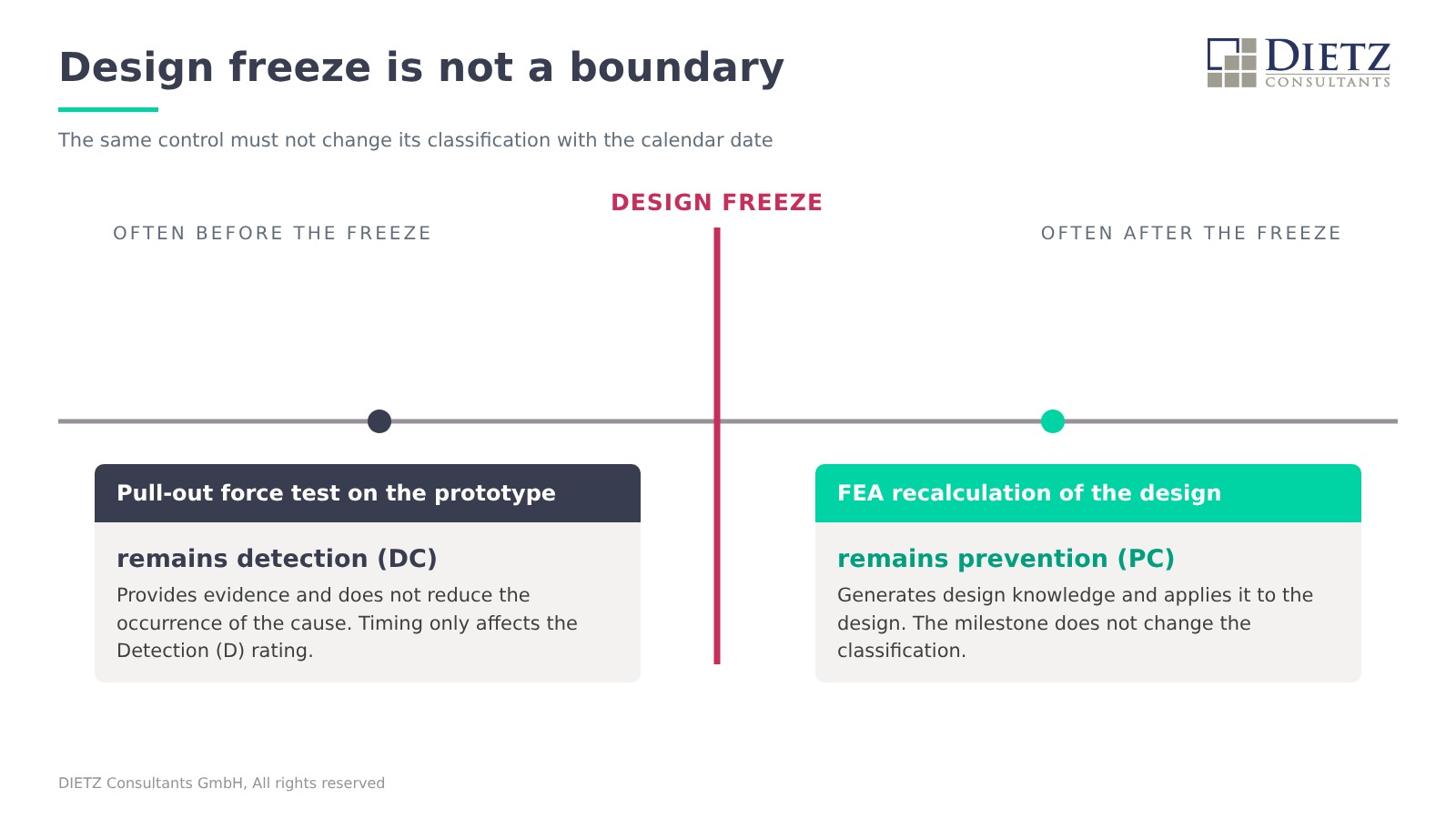
A definition that classifies the same control differently depending on the calendar date does not stand up to methodical scrutiny (see Figure 2).
A pull-out force test on a prototype often takes place before design freeze. It nevertheless remains a detection control, because it provides evidence and does not reduce the occurrence of the cause. An FEA recalculation of the design, on the other hand, often takes place after the freeze. It remains a prevention control, because it generates design knowledge and applies it to the design.
The grain of truth in the timing argument
The rule of thumb is not entirely wrong. The AIAG/VDA Handbook itself also shows prevention and detection on a timeline in Figure 2.5-1, before and after the design decision. For each cause-failure chain, the design (prevention) comes first and the evidence (detection) afterwards. This sequence, however, applies per chain and not to a project milestone that is set for all chains at the same time.
Classified by character
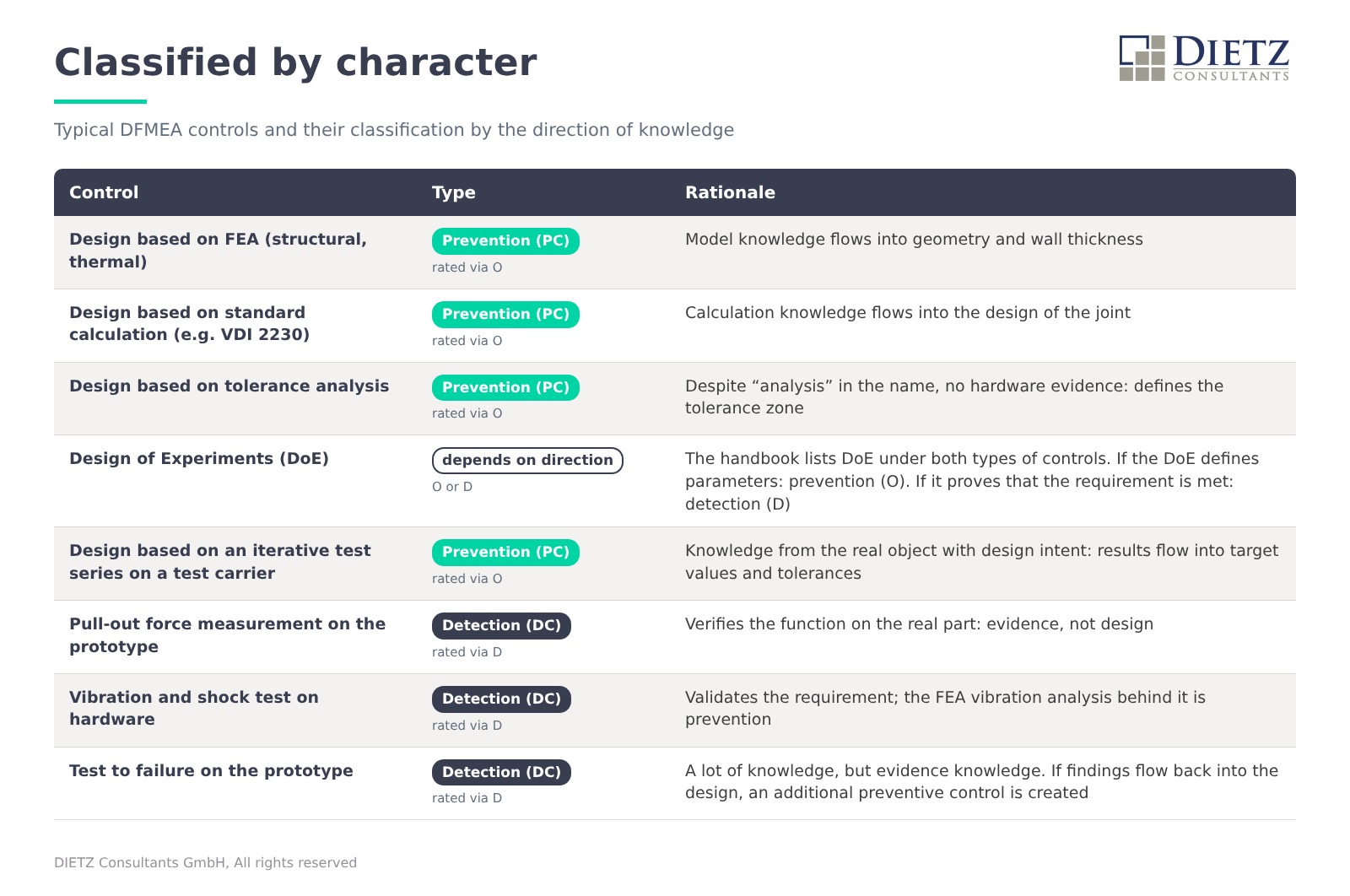
The same test method can take on both roles; the intent decides. The AIAG/VDA Handbook itself lists Design of Experiments (DoE) under prevention (see Figure 2.5-1) as well as under detection (see Chapter 2.5.4). The table below shows typical controls and their classification.
Three traps you should avoid
These traps arise when the project schedule takes over the work of the method.
Classification by project phase
"Prevention before freeze, detection after freeze" is the most common false rule. Classify by the direction of knowledge instead: into the design (O) or into the evidence (D).
Every prototype activity as detection
Hardware being involved does not automatically mean detection. Check the intent: an iterative test series that defines design parameters is a prevention control.
Silent relabeling
A test to failure is often declared prevention after the fact because its results proved useful. Keep the evidence in detection. If findings flow back into the design, document a new prevention control.
Example
A connector must not come loose under vibration. In the DFMEA, the failure cause is "Snap hook undersized", the failure mode is "Connector comes loose under vibration". The team collects the controls and classifies them by the direction of knowledge:
- Design of the hook geometry according to FEA: the knowledge flows into wall thickness and radii. Prevention, rated via O.
- Iterative test series on a test carrier to define the overlap: the results define target value and tolerance. Prevention, even though hardware is tested.
- Pull-out force measurement on the prototype against the target value from the specification: the result is evidence. Detection, rated via D, even if it takes place before design freeze.
- Vibration test on the assembly sample: validates the requirement. Detection.
- Test to failure: it shows a margin smaller than expected. The test remains detection. The resulting change to the hook geometry is documented as a new prevention control in Step 6 Optimization.
With this classification, the assignment to O and D remains stable across all revisions, even when dates in the project plan shift.
Conclusion
Prevention brings knowledge into the design, detection brings knowledge into the evidence.
Ask for every control in the workshop: where does the knowledge flow? The answer determines whether O or D is rated.
Would you like to standardize the rating of controls in your DFMEAs or train your facilitators in Risk Analysis according to AIAG/VDA?
We support you with facilitation, reviews and training, including in-house. Get in touch: www.dietz-consultants.com
Author: Winfried Dietz, CEO Dietz Consultants GmbH
Winfried Dietz is CEO of Dietz Consultants GmbH and has supported development organizations worldwide in introducing and maturing the FMEA methodology for more than 30 years. He is a trainer, author and speaker for FMEA according to AIAG-VDA. Find more from the FMEA Quick Tip series on LinkedIn.