

SAE 1025 and AIAG-VDA: Two FMEA Worlds, One Method Core
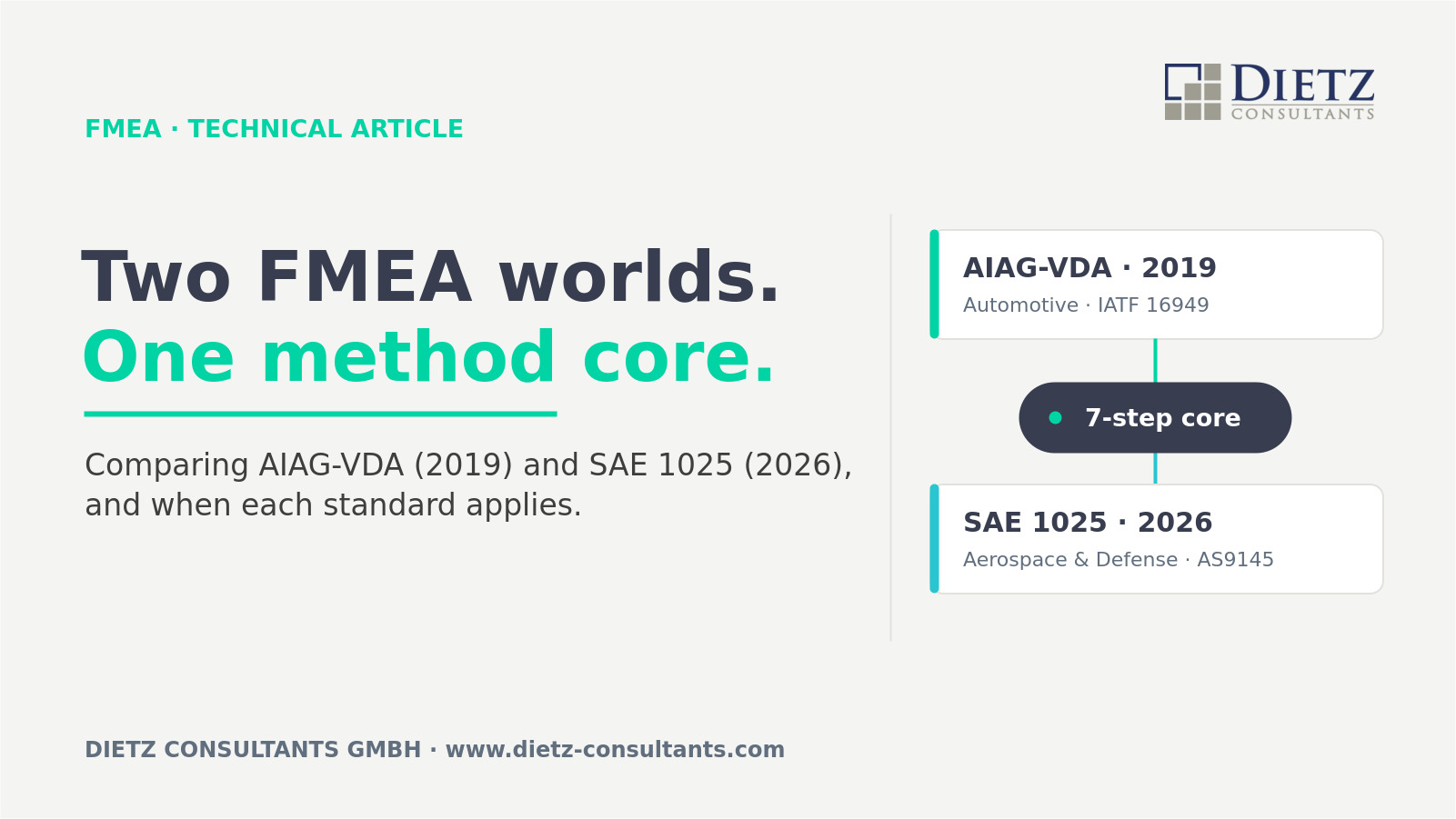
Whenever a new standard appears, a reflex kicks in: parallel templates, parallel training, parallel reporting. The result is divergent ratings, double maintenance and unclear ownership. Instead of deepening, method knowledge splits into two separate worlds. With SAE 1025 (2026) alongside AIAG-VDA (2019), exactly this question comes up again, and it quickly heads in the wrong direction.
This article shows why both standards share the same method core and how to configure it so that it serves both industries without doubling the organisation. Afterwards you can decide with confidence which standard applies to which supplier regime.
AIAG-VDA and SAE 1025 share the same method core
Both standards build on the same FMEA methodology, the 7-step approach. The sequence stays the same regardless of the industry the FMEA runs in: Planning and Preparation, Structure Analysis, Function Analysis, Failure Analysis, Risk Analysis, Optimisation and Results Documentation. That is the shared DNA.
What differs is not the core but its configuration, and the question of which supplier regime accepts it. That is why the right answer to a new standard is not to clone the entire world, but to configure the core you already have.
AIAG-VDA 2019: the standard for the automotive industry
The AIAG-VDA FMEA Handbook of 2019 is the method core for the automotive world. It is embedded in IATF 16949 as well as in APQP and PPAP, and it is accepted across the global OEM supply chain in Europe and the USA, from BMW, Volkswagen and Mercedes-Benz to Ford and GM through Stellantis and Daimler Truck.
At its centre is Action Priority (AP), derived from Severity, Occurrence and Detection, which replaces the classic Risk Priority Number (RPN). Design FMEA and Process FMEA run continuously coupled rather than separately. For safety-relevant systems in the field, FMEA-MSR (Monitoring and System Response) extends the approach.
SAE 1025 (2026): the standard for aerospace and defense
SAE 1025 was published in January 2026 by SAE International and forms the method core for AS9145 in aerospace and defense. The standard replaces the decades-old MIL-STD-1629A and consolidates previously separate approaches such as SAE J1739 and ARP5580. In doing so, FMEA becomes an umbrella term that includes the criticality analysis.
Four FMEA types under one umbrella
SAE 1025 brings together four FMEA types: the Design FMEA for product development risks, the Software FMEA for software-specific risks, the Supportability FMEA for maintainability and serviceability, and the Process FMEA for manufacturing and operational processes. The Process Flow Diagram and the Control Plan are integral parts, not add-ons. One addition is that recommended actions are now carried in a separate column. A quantitative criticality analysis based on failure rates is optional and only intended on explicit request.
AIAG-VDA or SAE 1025: which standard for which regime?
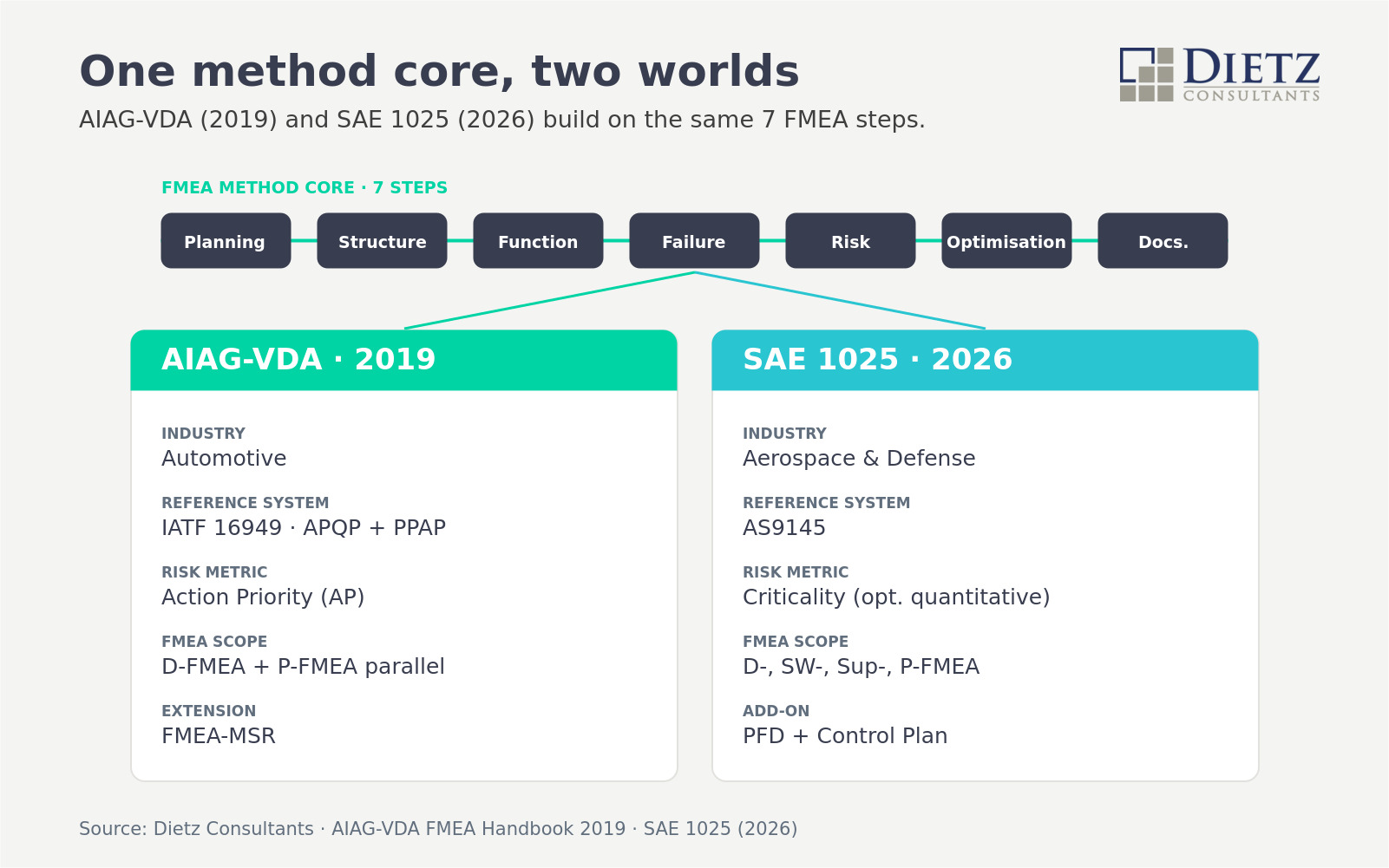
The choice does not depend on preference but on the customer's supplier regime. Anyone delivering under IATF 16949 works with AIAG-VDA. Anyone delivering under AS9145 works with SAE 1025. The method core stays the same in both cases, what differs is mainly the risk metric and the range of FMEA types.
The decisive point is to keep the rating logics clean. Action Priority stays Action Priority, and the quantitative criticality stays failure-rate-based. Mixing the two destroys exactly the comparability an FMEA is meant to create.
Three reflexes to drop
First, do not build two parallel FMEA organisations, run one method core with two industry-specific configurations. Second, do not treat the standards as competitors, sort them by supplier regime, AIAG-VDA for IATF 16949, SAE 1025 for AS9145. Third, do not mix the rating logics, keep each within its own system.
Example
A precision machining supplier delivers to an automotive OEM under IATF 16949 and, at the same time, to an aerospace prime under AS9145. Instead of building two separate FMEA departments, it maintains one shared 7-step core. Structure and function analysis follow the same system for both customers. Only at the rating stage does the process branch: the automotive scope is prioritised via Action Priority, the aerospace scope via the criticality analysis under SAE 1025. This removes duplicate training and keeps method knowledge in one place.
The standard does not choose itself, your supplier regime chooses it for you. Master the shared method core, and both worlds open up without doubling your organisation.
Do you deliver into both worlds and want to set up your FMEA core to be future-proof?
Talk to the FMEA experts at Dietz Consultants: www.dietz-consultants.com
Author: Winfried Dietz, CEO Dietz Consultants GmbH
Winfried Dietz is the CEO of Dietz Consultants GmbH and has been supporting development organisations worldwide in introducing and maturing the FMEA methodology for over 30 years. He is a trainer, author and speaker for FMEA according to AIAG-VDA. Find more from the FMEA Quick Tip series on LinkedIn.